Task 1: Summaries:
It has been widely thought throughout time that the Amazon Rainforest was the ‘first Eden’, essentially untouched by man. However, this is not completely true; over the last 25 years, scientists have acknowledged that the rainforest has been just as affected by humans as many other places. The Amazonian people have shaped and protected their habitat. Humans have lived in the rainforest for about 13,000 years. Scientists have recently assessed the many species of plants in the rainforest and found that more than half of the area is made up of 1% of the species (227). The frequency of many of these species have reached an estimated 5 times what they would be if it were left to chance. It was then supported with evidence that the frequency of some species depended on their distance from pre-Columbian communities, implying a domestication of plants. Archaeologists hope that this knowledge can be used to locate settlements. However, some people are sceptical of these findings, noting the long time-span between now and the existence of the settlements these findings are based upon. Some hypothesise that the appearance of plants are dependent on other factors, such as the bats that were previously found to have spread plants in the past.
1.8 billion trees can be found in the Sahara Desert, discovered through satellite learning from NASA. The area was previously thought to be virtually desolate and uninhabited by trees and shrubs. This was due to under-developed technology and a lack of interest in counting trees outside of forests. Knowing about these trees is important when considering the global carbon budget, important for programs that promote agroforestry, and when determining the species of tree. This process only took a matter of hours, owing to a new algorithm.
Task 2: Sahara Desert map:
One tree can absorb around a ton of CO2 emissions in its lifetime, and 40 billion tons of CO2 are released by humans each year. Therefore, we would need 40 billion trees to be planted in order to balance these numbers out. It is estimated that 1 million trees take up 20,000 acres of land. Therefore, 40 billion divided by 1 million results in 4,000. Multiplying this figure by 20,000 makes 800,000,000 acres of land necessary to create a Saharan Forest which could take in all CO2 emissions from human activity. This is 35.19% of the 2.273 billion acreas of land making up the Saharan Desert.
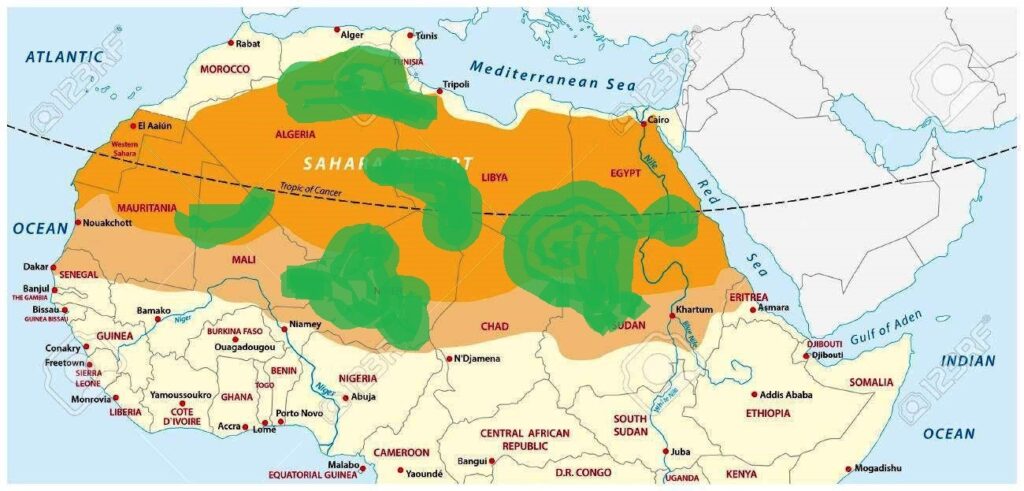
The above image shows the size of the Saharan Desert, the countries it includes, and the general areas of the natural aquifers in the area.
I present the idea that two great forests should be created in the Saharan Desert, each drawing from one of the two seas/oceans directly surrounding it.
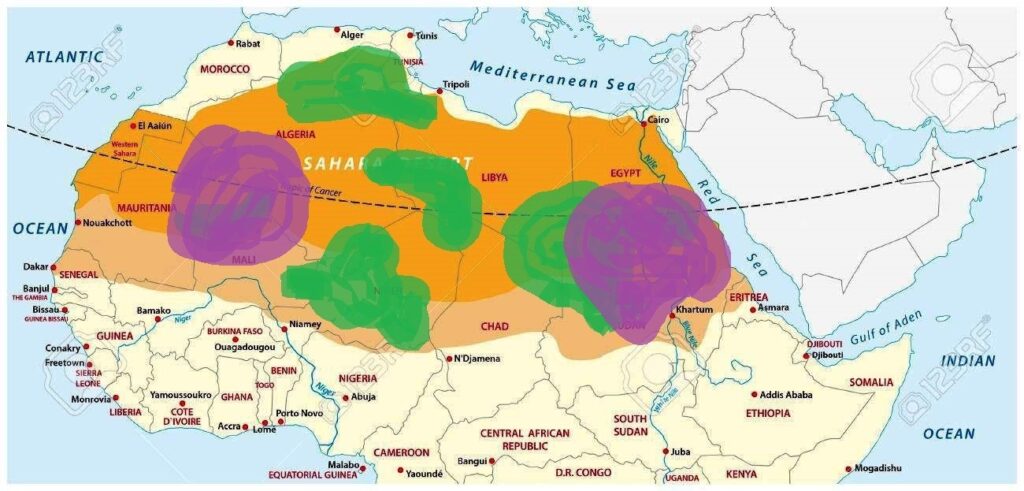
The purple areas indicate the forests. I would suggest that the one on the right would draw from the red sea, and take over large parts of Sudan and Egypt. The forest on the left of the map would draw from the Atlantic Ocean, flowing through Mauritania to reach the area taking up parts of Algeria, Mali and Mauritania. This large an area of land will doubtlessly have implications for the areas surrounding it, but may be able to solve the CO2 crisis.
Task 3:
Climate change is threatening to reduce the amount of clean water that will be available to drink. In order to solve this problem, a new desalination plant is being built in California, which will produce 50 million gallons of water every day. Coastal water reserves are also being threatened by rising sea levels. Although the ocean is a big source of water, the salt makes it undrinkable. However, there have been a few ways that have been discovered to make saltwater drinkable. Desalination is however very expensive.
The first method is distillation, which is an old method of removing salt, evaporating water and then making it into a liquid again. Distillation plants run on electricity to make the process faster. However, smaller scale distillation machines can be bought for individuals, although this requires a lot of energy and does not produce a very large amount of water.
The next method is reverse osmosis, which is the most common method used. It uses high pressure pumps to purify water. A new method is being developed to make this process cheaper, easier and requiring less energy. It is cheaper than distillation, but can still be expensive, which means that not every community that needs water will be able to use this method. Depending on the size of the plant and the systems it uses, this can be extremely pricey.
Thirdly is forward osmosis, which relies on the natural process of osmosis, allowing the water to separate from the salt in different departments. However, this method is not very effective at ridding the water of all salt, meaning that the process of desalination must also be used to make the water completely pure. This is quite a new process, and is very effective at making water clean of other impurities. The process also uses comparatively less energy, with reports showing a 47% reduction in energy compared to reverse osmosis. Nevertheless, some reports have found it to be less energy efficient.
Finally, electrodialysis can use electricity to draw water away from the salt. However, with an opposite problem to forward osmosis, this method is useful to separate salt and water, but not effective at cleansing the water from other impurities overall. This fault is being worked upon, however, and it is noted that the process overall is faster and can work on larger amounts of water overall.
More time must be dedicated to these processes due to the high cost and energy use associated with them, and also the possibility of the processes being harmful to the environment, although they may soon become a widely viable option.