Introduction:
In planning for a great Saharan Forest, one large enough to combat the very large threat of increasing greenhouse gases, certain precautions must be taken to avoid the complete disaster that would be a forest fire taking down the whole project. Aside from the obvious methods to extinguish fires, including water and chemicals, there are methods and techniques that can be used in planning and maintaining my planned Saharan forest, which will minimise the chances of fires starting and minimise the chance that they will spread to large amounts of forest. Once started and permitted to become large and vicious, wildfires can be very difficult to extinguish, and can make much damage to people and wildlife. Examples of the large and persistent wildfires in Australia, California and Portugal, partly resultant of an ever-worsening climate situation, warn of the disastrous consequences of bad planning and management. Considering the expense included in this project, it is essential that large amounts of the forest do not catch on fire, essentially worsening the Carbon Dioxide problem that it was built to combat.
Tree type:
One method of preventing forest fires is ensuring that the trees that are planted are somewhat fire resistant. Eucalyptus trees are one of the most flammable trees known, and they cover more than three-quarters of Australia’s forests, which is why they are so vulnerable to large and destructive forest fires. This is the result of the flammable bark, which hangs off the tree and allows it to spread up the trunk. This can then be blown on the wind, spreading the fire for great distances, until it becomes largely uncontrollable. These trees are fast growing, however, and so have been involved in reforestation projects elsewhere. They can also be associated with the forest fires in California and Portugal. The fact that so many of Australia’s wildlife relies on these trees for their habitat makes replacing them unlikely, but this should not be a problem if my forest is made with biodiversity in mind when choosing a wide selection of trees. Variation in types of trees in large forests is very helpful when it comes to preventing fires from spreading. While Eucalyptus trees are easy to burn when crowded together, for example, Oak trees are generally more resistant to fires, and so a forest which is not compressed with Eucalyptus trees will spread slower and therefore be easier to control.
Prescribed burning:
Prescribed burning plans fires in a controlled situation, which has been found by scientists to be effective in preventing bushfires and ensuring that the damage done by wildfires is lessened. It has a history in Australia, as Aboriginal natives had been using this method, which they called “cultural burns”, for thousands of years. The method is said to replenish the earth and encourage biodiversity, as well as encourage rain. It is currently a common method to combat wildfires in Australia – the 2011 Perth Hills bushfires were helped by the fact that they had been given prescribed burning, limiting the damage it did. Fire suppression has been named as one of the causes of such violent wildfires in California, an aspect that they are trying to reverse through this method. Determining the area, plants, management and day in which these fires will be started is a rigorous process which must be responsibly organised, and could possibly be a method of managing the Saharan forests.
Human behaviour:
It must be ensured that, should a forest fire occur, the harm to locals is minimal. In Portugal, the government was criticised for a lack of “safety lanes” between the forests and local houses, which means that firemen had to split their attention between evacuating locals from their homes and suppressing the fires. Locals argued that, had the government put more thought into separating homes and forest, the fires could have been managed more effectively.
Managing human behaviour can be a good prevention of forest fires. As Nina S. Oakley noted about the California wildfires, more often than not, the ignition of a forest fire is a human action, rather than nature. 9 out of 10 of forest fires in the U.S. are caused by humans. This can include downed power lines, a truck sending sparks when it bumps into the pavement, such as in the 2018 Carr Fire, a result of fireworks, and many more reasons. Moving to areas near forests, which are inclined to burn, can be a contribution to this. Of course, the fact that these areas are dry, hot and may not have been managed properly are big contributions to the spreading of these fires. However, ensuring that locals do not engage in such risky behaviour, nor live near enough to primarily affect the fires, could minimise them in the first place.
Management:
Portugal’s forest fires have been very deadly. It is a very forested country, and with 85% of the forests being privately owned, fragmented between different owners, there has been a severe lack of management which has encouraged the uncontrollable fires. To blame is also the lack of planning that the government engaged in, in forming a forest-fire protection plan. In order to ensure that forest fires are handled accordingly, the authorities must know how to effectively stop them. The emergency response must be quick – a suggestion in Portugal was to make SMS alerts to help inform locals of forest fires – and emergency services must have all the technology they need at hand. Building watchtowers or satellites to look for fires across the forest can be effective in enforcing quick action. The weather should be monitored to know when the forest is of particular risk of catching fire.
Maintain plants well:
It is a good idea to make sure that the forest trees are as resistant to fires as possible, which means removing dead branches on the trees, so that they cannot ignite and spread the fire. Although it is not realistic that all dead things can be removed from the forest floor, such as fallen leaves and dry plant material, keeping the forest areas as clean from dead plants as possible could help reduce the ferocity of the fires. Dead and diseased trees should be removed entirely. Hopefully, the constant flow of seawater-turned-freshwater will help the forest land from becoming too dry, but these precautions will ensure that the forest stays healthy. It is also a good idea to spread each individual tree a decent distance away from another tree, slowing down the fire.
Geographical location:
Just as “safety lanes” between forest fires and house can reduce the risk of houses being burnt, space between areas of forest can reduce the risk of fires spreading a large amount of distance, named “firebreaks”. These act as barriers to the fire, and can be man-made areas such as roads or natural gaps in vegetation. However, in some cases, such as in Australia’s Eucalyptus-rich forests, firebreaks have little impact, as the Eucalyptus’ nature means that the burning pieces of bark can easily travel across distances. They have also been found to be ineffective in certain circumstances elsewhere, such as in the 1988 fires across Yellowstone National Park, which managed to cross the natural firebreak of the Lewis Canyon.
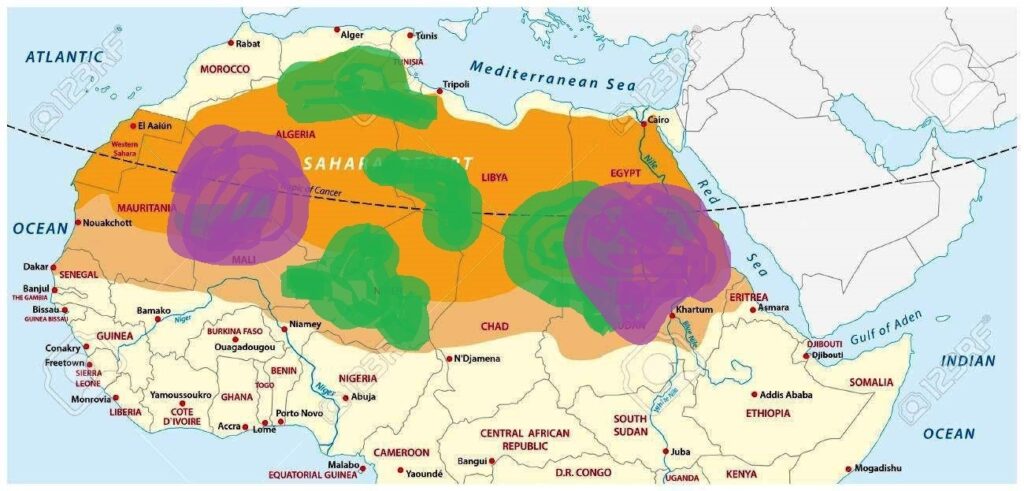
In the case of my forest, I hope to have much more diversity in my trees than those in Australia, which will hopefully improve the effectiveness of firebreaks. Also, in my previous map plan for the location of my forests, I have highlighted two very large purple areas. This large plan gives space for firebreaks of very large areas, in order to make it very unlikely that fire would be able to cross them. The two big areas will mean that the entire forest will not be condensed into one area, and that people will be able to live between the forest areas safely. Seeing as my previous calculations decided that 40 million hectares would be sufficient to equalise the Carbon Dioxide being released into the atmosphere, forest areas of 50 hectares each, at least, could be responsible planning, ensuring that the entire Sahara forest will not be on fire if one area did catch fire. The two purple areas would each have 20 million hectares each.
Conclusion:
Forest fires have an evident correlation with climate change, as it encourages drought and high temperatures, aspects which can be associated with the Saharan Desert as a whole. However, as the Saharan forests I plan to construct come to fruition, and take effect in battling global warming, this will hopefully reduce the risk of forest fires starting in woodland across the world. Nevertheless, it is very important that those who plant trees take precautions to prevent the kind of disasters that have occurred in similar situations in the past. Using methods to do with strategic planting and biodiversity in plants, as well as management techniques, such as prescribed burning, safety lanes, firebreaks, and enhanced technology, can help minimise the threat of forest fires, and ensure that many benefits come from this very large investment.
Information from:
https://portal.ct.gov/DEEP/Forestry/Forest-Fire/Forest-Fire-Prevention-Tips
https://www.bbc.co.uk/news/world-europe-40341180
https://www.dpaw.wa.gov.au/management/fire/prescribed-burning
https://www.sciencedirect.com/topics/earth-and-planetary-sciences/prescribed-burning
https://www.nytimes.com/article/why-does-california-have-wildfires.html
https://www.bbc.co.uk/news/world-51132965
https://www.bbc.co.uk/news/world-australia-51043828
https://www.doi.gov/blog/10-tips-prevent-wildfires
https://inexpensivetreecare.com/blog/prune-trees-to-reduce-fire-risk/